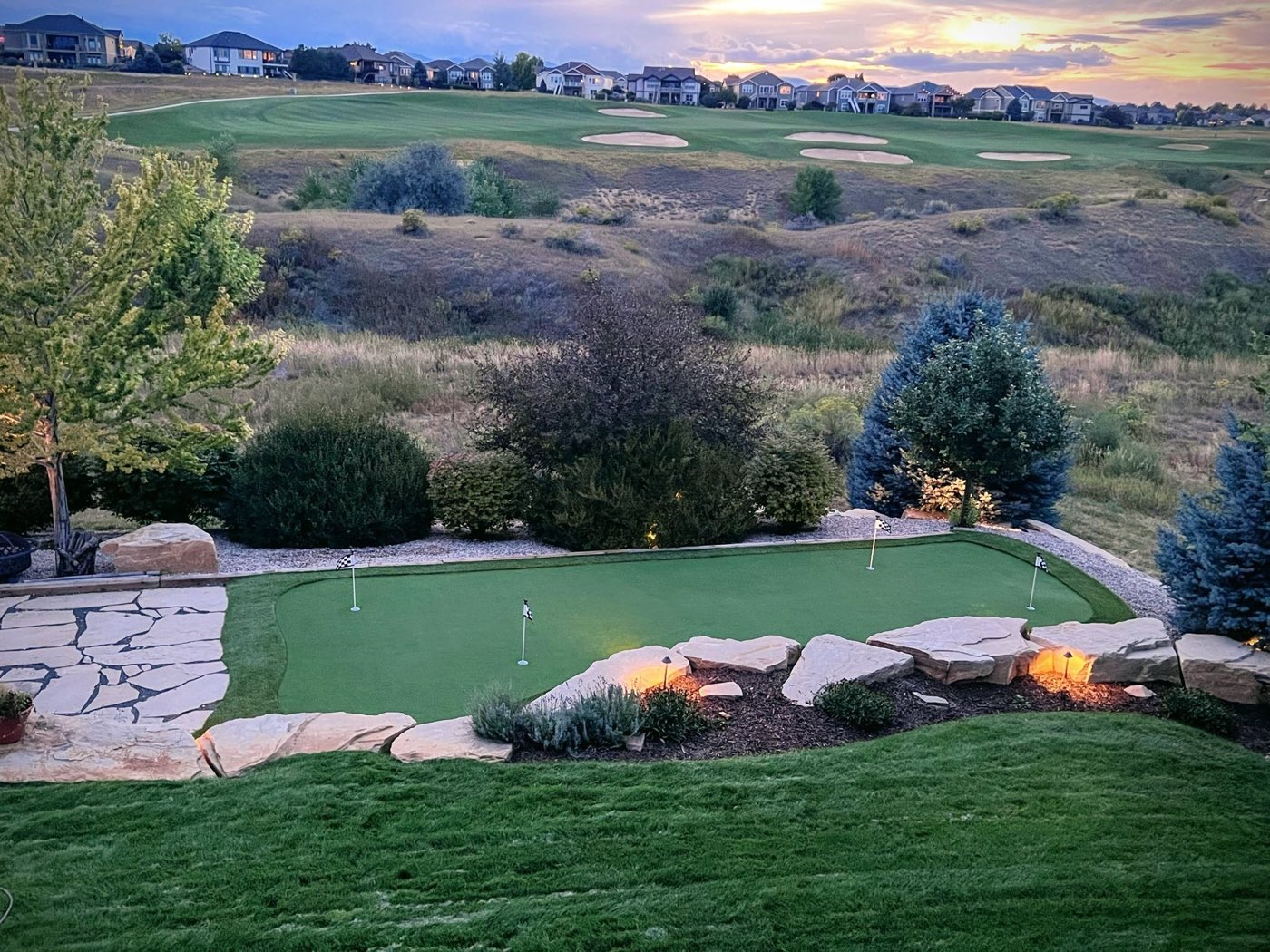
How do you clean artificial turf without damaging the natural stone, pavers and lighting around it?
Limestone, travertine and marble are calcium carbonate and etch on contact with acid, so a mineral descaler stays on the turf side, pre-wet and masked at the border. Oxidizers and algaecides are a different chemistry, closer to what stone care itself allows, but still get rinsed before they dry at a joint. TIMELESS Turf Restoration works that edge, and the wiring and plantings along it, across the Grand Strand.
Why stone reacts differently than turf
Turf itself does not care much what touches it; fiber and infill are built to take rinse water and our products without a chemical reaction. Natural stone is different. Limestone, travertine and marble are all calcium carbonate at the core, and, per the Natural Stone Institute, the stone industry's own trade group, are vulnerable to alteration by exposure to mild acids, the same reaction that leaves a dull ring where lemon juice or wine sits on a countertop. That etching mechanism means the mild descaler we use on white, chalky mineral crust is the wrong thing to let reach the stone beside it.
| Material | Reacts to acid? | What that means here |
|---|---|---|
| Limestone, travertine, marble | Yes; etches and dulls on contact | Keep any acidic product off it entirely, even briefly |
| Granite, slate, quartzite | Generally resistant to most acids | Etching is not the main risk; staining and sealer damage still are |
| Sealed concrete or clay pavers | Depends on the sealer, not the paver | The wrong product can strip or discolor the sealer film |
Keeping the mineral descaler off the stone
The white, chalky crust that private-well irrigation or dried salt leaves on turf, our white chalky patches problem, gets treated with a mild descaler, never muriatic acid, left a few minutes and rinsed well. That descaler works because it is acidic enough to dissolve mineral deposits, the same property that makes it wrong for calcareous stone at the edge of the same area.
- Pre-wet the border. A stone or paver edge that is already wet resists soaking up a stray splash, buying seconds to catch it before it etches.
- Mask the line. Tape, a sheet, or simply working the descaler in from the turf side toward the stone rather than up to the line keeps the product where it belongs.
- Rinse the border regardless. Flush the stone side with plain water once the turf side is done, even where nothing visibly reached it; a light mist etches as surely as a splash, just more slowly.
Brian prices it by square foot before any work starts, and every job ends blown clean.
Oxidizers and algaecides near stone and sealed pavers
An oxygen-based oxidizer and a turf-safe algaecide are not acids, and that matters at a stone edge. The Natural Stone Institute's own care guidance lists a diluted hydrogen peroxide solution as an accepted way to treat algae and mildew on stone, closer to what stone care already recommends than to what it warns against. A turf-safe algaecide, usually a different chemistry again, has not been tested against every stone and sealer combination, so the same caution applies even though it is not an acid; our turf cleaning products guide covers what each category does.
Treat both the way the descaler gets treated: worked in from the turf side, kept off a joint or stone edge directly, and rinsed at the border before it dries. A sealed paver holds up to an occasional splash rinsed off promptly; what damages a sealer is product left to pool and dry against the same joint visit after visit.
Where the rinse water ends up
Loosened sand and infill do not stay on the turf once a high-volume rinse runs. Water flowing off a treated area crosses whatever border sits downhill, and where that border is a paver walkway, the grains it carries settle into the open joints rather than draining through. A season of that builds sediment that holds moisture against the paver base longer than the joint was meant to. Boulders and river-rock borders at the low edge collect the same material in the gaps between stones, showing as a pale sand line on whatever face faces the turf. None of this calls for more pressure; a pressure washer near a joint or boulder bed drives debris in under force rather than letting a controlled rinse carry it away, which is why we never use one near turf.
Working the rinse pattern from the border inward, rather than straight at a joint or boulder bed, keeps most of it from ever reaching those gaps, and brushing out whatever settles there at the end of a visit beats letting it compact in before the next rain repeats it.
Lighting, wiring and the plants at the edge
Low-voltage landscape lighting at a turf border usually runs on wiring buried an inch or two down, shallow enough for a power brush or edging tool to catch if a run has crept up over a season of settling. Walking the edge before brushing it hard, noting where a fixture stake sits loose or wire shows, is the difference between working around it and finding out the hard way. A transformer or junction box near the line gets kept dry rather than rinsed directly, since it is an electrical enclosure, not turf.
A planting bed against the same edge, azaleas, liriope, whatever borders the yard, sits close enough to catch overspray from a descaler, algaecide or antimicrobial pass. Rinsing foliage that took a direct hit as the visit goes, rather than waiting until the end, keeps a splash from sitting on leaves any longer than it has to.
What it costs
Protecting the stone, pavers, wiring and beds around a treatment area does not add its own line item; it is built into how we work an edge, the same way it would be on any turf visit near anything that is not turf. Pricing still follows measured square footage and condition: an Essential Clean starts at $199 for up to 500 square feet, and a hard-water and stain removal pass for mineral crust or an algae and mold treatment for a shaded strip near stone are both part of a Premium Restoration or available on their own. If the boulders or river-rock border themselves need resetting, that is a hardscape job outside what we do; we clear what has washed into them and work around them rather than moving them.
Free quote, priced by square foot. You approve any add-on before we do it.