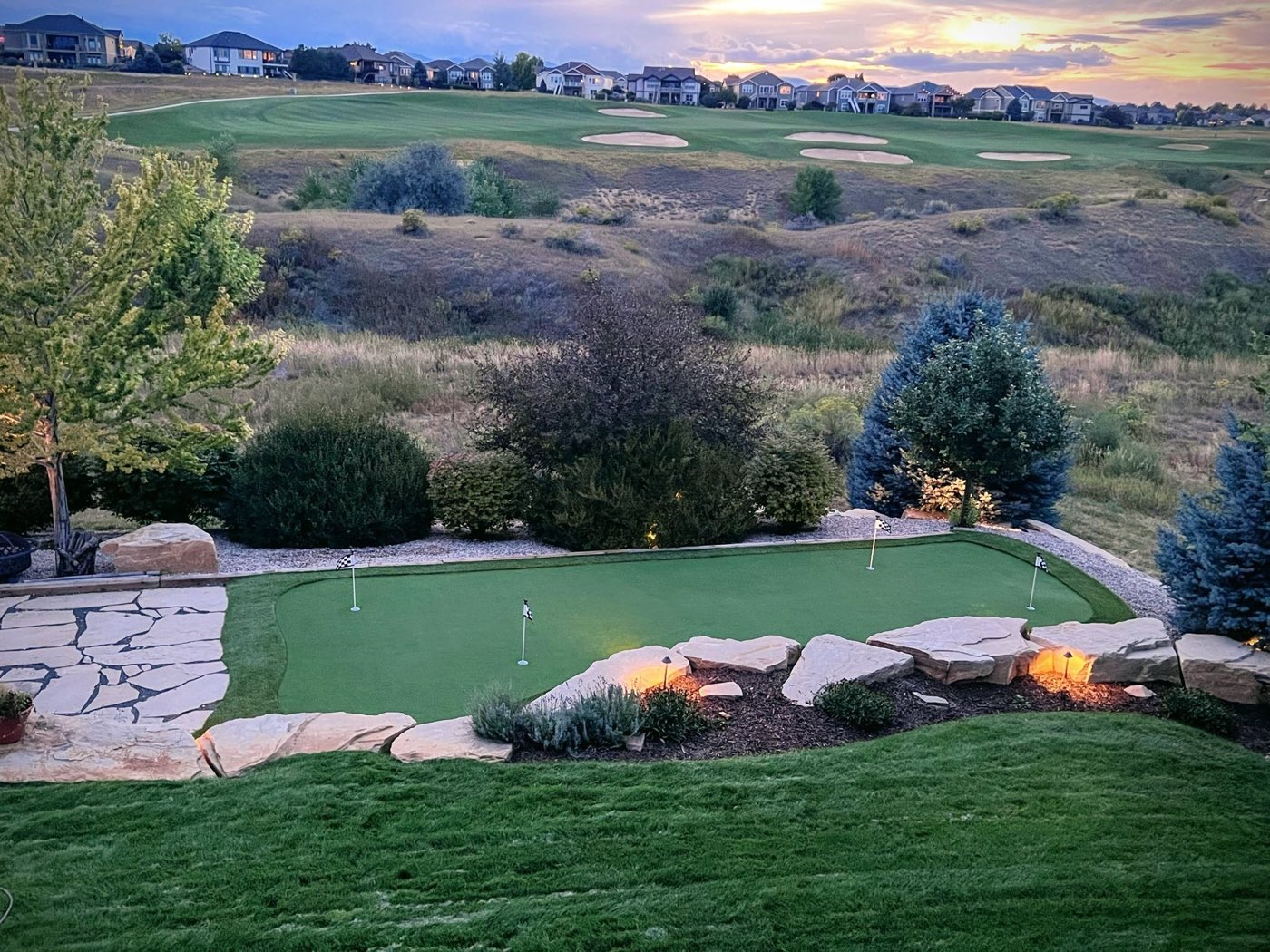
How do you maintain a backyard with a putting green, pet area, pool surround and turf lawn?
Each surface gets its own frequency: the pet zone rinsed and treated most, the pool surround close behind, the lawn one or two deep cleans a year, and the green on its own sand schedule. On a combined visit, dwell-time treatments go down first and the green gets cleaned last, so nothing blows onto fresh sand. TIMELESS Turf Restoration schedules all four across the Grand Strand.
Four surfaces, four clocks
A putting green, a pet zone, a pool surround and a plain lawn fail in different ways, so one calendar cannot cover all four. The green's problem is sand: depth and how recently it was rolled decide whether a ball rolls true, covered on our backyard putting green care page. The pet zone's problem is bacteria working in the infill, which coastal humidity keeps active most of the year, on our pet turf care page. The pool surround's problem is near-constant moisture plus chlorine and sunscreen residue, close to the same recipe from a different source, on our pool surround turf care page. The lawn, with nothing else using it, is mostly debris and pollen. Treat all four the same and you over-service the lawn or under-service the rest.
The order to work a combined visit
When one visit covers all four backyard surfaces, order matters as much as the tasks. Debris comes off the whole property first, a broad blow-off across the lawn, pool deck and green alike, before anything gets wet. From there:
- Pet zone first. The enzyme odor treatment needs real dwell time, so it goes down early and works while the rest of the visit happens elsewhere.
- Pool surround next. Rinsing chlorine, salt-system residue and sunscreen off that strip happens while the pet zone is still dwelling.
- Lawn third. Power brushing and the main rinse kick up more dust and debris than anything else on the property, which is why it does not go last.
- Green last. Brushing, top-dressing and rolling only make sense once nothing else is going to land on the surface afterward; a blower or brush working elsewhere can put pollen or sand in the air.
The same logic applies to foot traffic: anyone who walked the pet zone or pool deck crosses the green last, so nothing tracked in gets carried onto it.
Brian prices it by square foot before any work starts, and every job ends blown clean.
An annual calendar, by surface
The Grand Strand's calendar drives all four schedules, just differently: pine pollen peaks late March into early April, hurricane season runs June through November and peaks in September, and summer humidity keeps everything but the green damp for months.
| Surface | Pollen (Feb–Apr) | Summer (May–Sept) | Hurricane (Jun–Nov) | Winter |
|---|---|---|---|---|
| Lawn | Blow off 2x weekly; hold the deep clean until pollen ends | Weekly blow-off; watch shade for algae | Debris and salt flush within two weeks | Light; a window for repair |
| Pet zone | Rinse more; pollen paste feeds the same bacteria as urine | Rinse 2-3x weekly; weekly enzyme spray | Check saturation; antimicrobial if flooded | Quiet; measure infill |
| Pool surround | Blow pollen off before it pastes near the coping | Weekly rinse; watch for algae, the dampest strip in the yard | Same flush; check drainage at the low edge | Light; treat algae before pool season |
| Putting green | Blow off 2x weekly; hold the top-dress until pollen ends | Weekly brush; check speed | Clear debris; check for floated sand | Monthly brush only |
Where cross-contamination happens
Four surfaces sharing a yard trade material whether anyone means them to or not.
- Pool water and chlorine. Splash-out and dripping feet carry residue off the pool deck onto the nearest strip of lawn or green; where the two sit close, that edge wants the same rinse attention the pool surround gets.
- Bunker or play sand. A short-game bunker or a kids' sandbox uses a different grade than the kiln-dried, rounded sand a green is top-dressed with. Tracked in on shoes, it mixes into the green's sand and changes how a ball rolls, the same way beach sand does after a storm.
- Dogs on the green. Paws carry residue from the pet zone onto the green's sand bed, and a dog using the green itself adds digging and urine it is not built to take. See dogs on a putting green.
Budgeting by square footage
Turf is quoted by measured square footage and condition, and a multi-surface yard adds up its zones the same way a single lawn would. Measure the lawn, pool surround and pet zone separately, then decide which need attention on the same visit; surfaces billed together only add their footage once, into whichever band the total falls in.
A 1,400-square-foot lawn on its own lands in the 1,001–1,500 sq ft band: an Essential Clean there runs $299 a visit, once or twice a year. A 300-square-foot pool surround plus a 180-square-foot pet zone add up to 480 square feet, in the Up to 500 sq ft band, both usually wanting the full Premium Restoration: $299 a visit, or $299 × 4 = $1,196 run quarterly. The green sits outside this math: quoted after a look, with typical backyard greens landing between $299 and $899 per our putting green restoration cost page.
What it costs
Running four surfaces on one property does not change how any of them is priced: lawn and pool surround follow the same square-footage bands as any other turf, pet-zone odor treatment is part of a Premium Restoration as usual, and a putting green restoration is quoted after we look at it. What changes is scheduling: a quarterly TIMELESS ELITE membership at $139 a month keeps the pool surround and pet zone on the tighter clock they need, while the lawn and green get looked at on their own longer intervals during the same stop. If the property is large enough that access, gates and multiple crews are part of the conversation, see private estates and large properties for how that side is walked and quoted; this plan is the yard's own schedule, not the property's logistics.
Free quote, priced by square foot. You approve any add-on before we do it.