How do I measure my artificial turf for a quote?
Break the area into rectangles, measure the length and width of each in feet, multiply, and add them together. For a curved bed, average the widest and narrowest points and multiply by the length. Putting greens are measured the same way, by the full footprint including the fringe. TIMELESS Turf Restoration prices visits across the Grand Strand by these same square footage bands, and confirms the exact number on site.
Key takeaways
- Break the yard into rectangles, measure each in feet, and add the areas together.
- For a curved or tapering bed, average the widest and narrowest width and multiply by the length.
- Putting greens are measured by their full footprint, fringe included.
- A rough measurement gets you within a price band; we confirm the exact number on site.
Why square footage, not a walkthrough guess
Our pricing runs in bands by square footage because that is what actually drives the time and material on a visit, not a guess at "medium yard" or "large yard." The more accurate your own number, the closer the quote you get over the phone or online lines up with the one confirmed at the visit.
The rectangle method
For most yards: walk the turf area and sketch a rough outline, break it into two or three rectangles the way you would cut a sheet of plywood into simple shapes, measure the length and width of each rectangle in feet with a tape measure or a measuring wheel, multiply length by width for each one, and add the results together for total square feet. A backyard that is 30 feet by 20 feet, with an L-shaped side strip 25 feet by 6 feet, works out to 600 square feet plus 150 square feet, 750 square feet total, which lands it in the 501 to 1,000 band rather than the one below it.
Brian prices it by square foot before any work starts, and every job ends blown clean.
Odd shapes and curves
For a bed that tapers or curves rather than running straight-edged: measure the widest point across and the narrowest point across, add them together and divide by two to get an average width, then multiply that average by the length of the run. This will not be exact to the square foot, but it is close enough to place the area in the right price band, which is the goal.
Putting greens
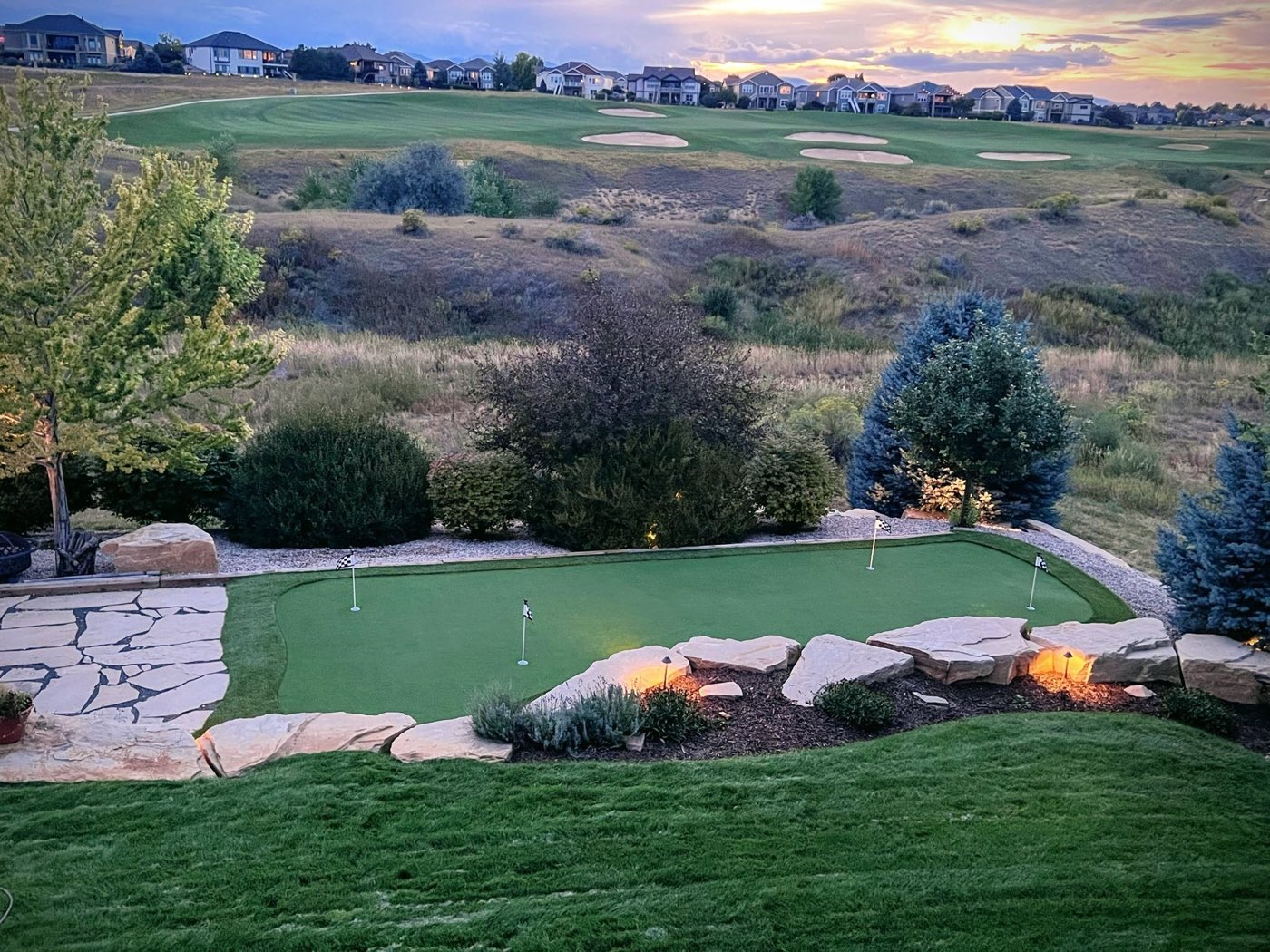
Measure a synthetic green by its full footprint, including the fringe or collar around the putting surface, using the same length-times-width or curved-average method as any other turf area. Greens are sized and quoted the same way as lawn turf, by total square feet, even though the surface itself is built differently. A green with several curved fingers or a figure-eight shape is easiest to measure as a few overlapping rectangles rather than one average width, the same rectangle method used on an odd-shaped lawn.
What to do with the number
Once you have a total, check it against the bands on our pricing page: up to 500 square feet, 501 to 1,000, 1,001 to 1,500, 1,501 to 2,000, 2,001 to 3,000, and 3,001 to 5,000, with anything larger quoted directly. A yard right on the line between two bands is worth a quick photo and a call rather than a guess, and our quote page takes both.
Where a rough measurement goes wrong
A single large rectangle guess tends to overstate an L-shaped yard, since the missing corner gets counted as turf. A curved bed measured only at its widest point overstates the average. Small planting islands or a fire pit cut out of the turf are easy to forget and should be subtracted from the total rather than left in.
Why we still confirm on site
Our visit always includes a walk of the area before starting, both to confirm square footage and to check the turf's condition, which is the second half of what sets an Essential Clean apart from a Premium Restoration. A measurement from the ground gets you a realistic price range, and the visit removes any doubt before work starts. The minimum visit is $199 regardless of how the math on a very small area comes out.
Free quote, priced by square foot. You approve any add-on before we do it.