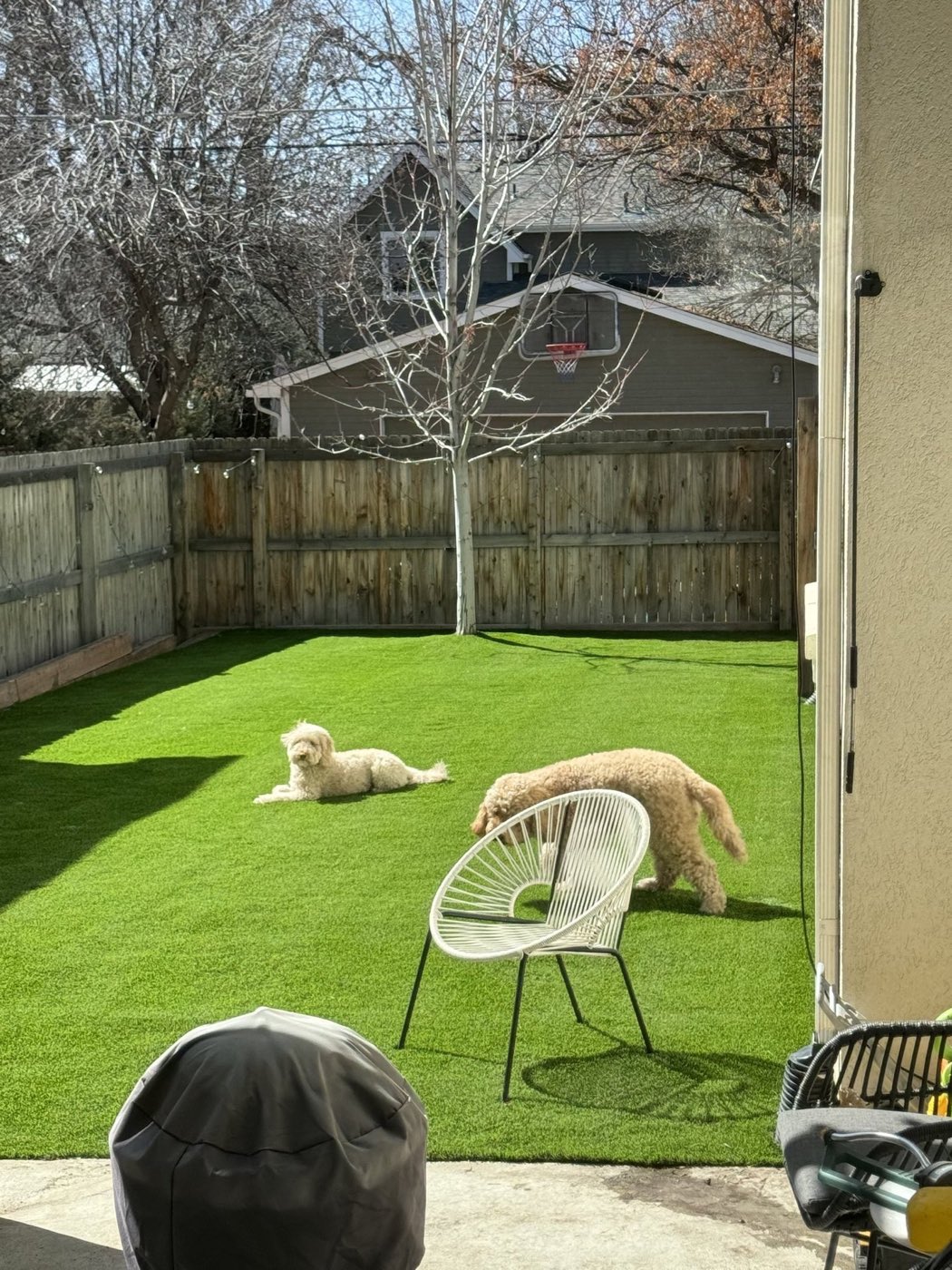
How do you fix bald spots in dog run turf?
Bald spots in a dog run are fixed two ways depending on whether the fibers are bent or gone. Fibers that are flattened and packed into thin infill come back with power brushing against the grain and an infill top-up. Fibers that have sheared off at the backing do not come back and the worn section is cut out and replaced with a matching patch. TIMELESS Turf Restoration does both across the Grand Strand, and will tell you which you have before starting.
Why the turns and the gate go first
A dog running a fence line plants its back feet and pivots at each end, and every pivot drags claws sideways across the fibers. At the gate it stands, spins and scratches while it waits. A turf fiber can be bent thousands of times and stand back up, but shearing is different: the claw catches the fiber near the base and cuts it. Once enough fibers are gone the infill under them is exposed, gets kicked out, and the neighbors lose their support and go next.
Thin infill speeds it up, because a fiber with nothing packed around its base bends at the backing instead of along its length. Heat speeds it up too. Fibers are softest on a July afternoon, which is also when the dog is running. Two dogs chasing each other wear a turn out in a fraction of the time one dog does.
Bent or gone: the hand-brush test
Kneel at the worst spot with a stiff synthetic-bristle brush and brush hard against the grain, a few strokes. Then look.
- The fibers stand up and the spot looks like the rest of the yard, just shorter. They are bent and packed. Brushing and infill will fix it.
- Short stubble, or you can see the backing between fibers. The fibers are sheared. Nothing brings them back.
- Fuzz and split fiber tips around the edge of the spot. Wear is spreading outward. The center gets patched; the ring around it gets brushed.
Also part the fibers and look at infill depth. In a healthy run the infill covers most of the fiber length. In a worn turn it is often almost gone, pushed out to the sides, which is half the reason the fibers went.
Brian prices it by square foot before any work starts, and every job ends blown clean.
Brushing helps, a patch fixes
For bent fibers, a power brush run against the grain in more than one direction lifts them, and the turn is topped up and leveled so the fibers have support again. That is included in every Essential Clean, from $199, and it is usually all a run under two years old needs.
For sheared fibers, the bald area is cut out square, a matching piece of turf is cut to fit, seamed in with tape and adhesive, infilled and brushed so the grain runs the same way. If there is an offcut from the original install it disappears; with a close match it reads a shade greener until it weathers in over a season. That is a turf repair, from $250. A pivot corner is a small area, so most dog-run patches sit near the bottom of that range.
Laying the run out so it lasts
The wear is where the dog turns, so change where it turns. Round off the corners of the run with a planter or a bench so the dog arcs instead of pivoting on one spot. Put a paver or a rubber pad inside the gate, where it waits, so the scratching lands on something that does not care. If the run is along a fence the dog patrols, a strip of pavers along that fence takes the traffic and the turf next to it stays whole. Keep the infill full, because it is the infill that lets a fiber bend instead of break, and brush the turns by hand monthly against the grain.
Call us when you can see backing, when a bald spot is bigger than a dinner plate, or when brushing no longer brings the turn back. Brushing and infill are part of any clean from $199; patches from $250. Heavy-use runs do best on the Pet Turf ELITE schedule, where the turns get brushed and topped up every quarter before they go bald.
Free quote, priced by square foot. You approve any add-on before we do it.