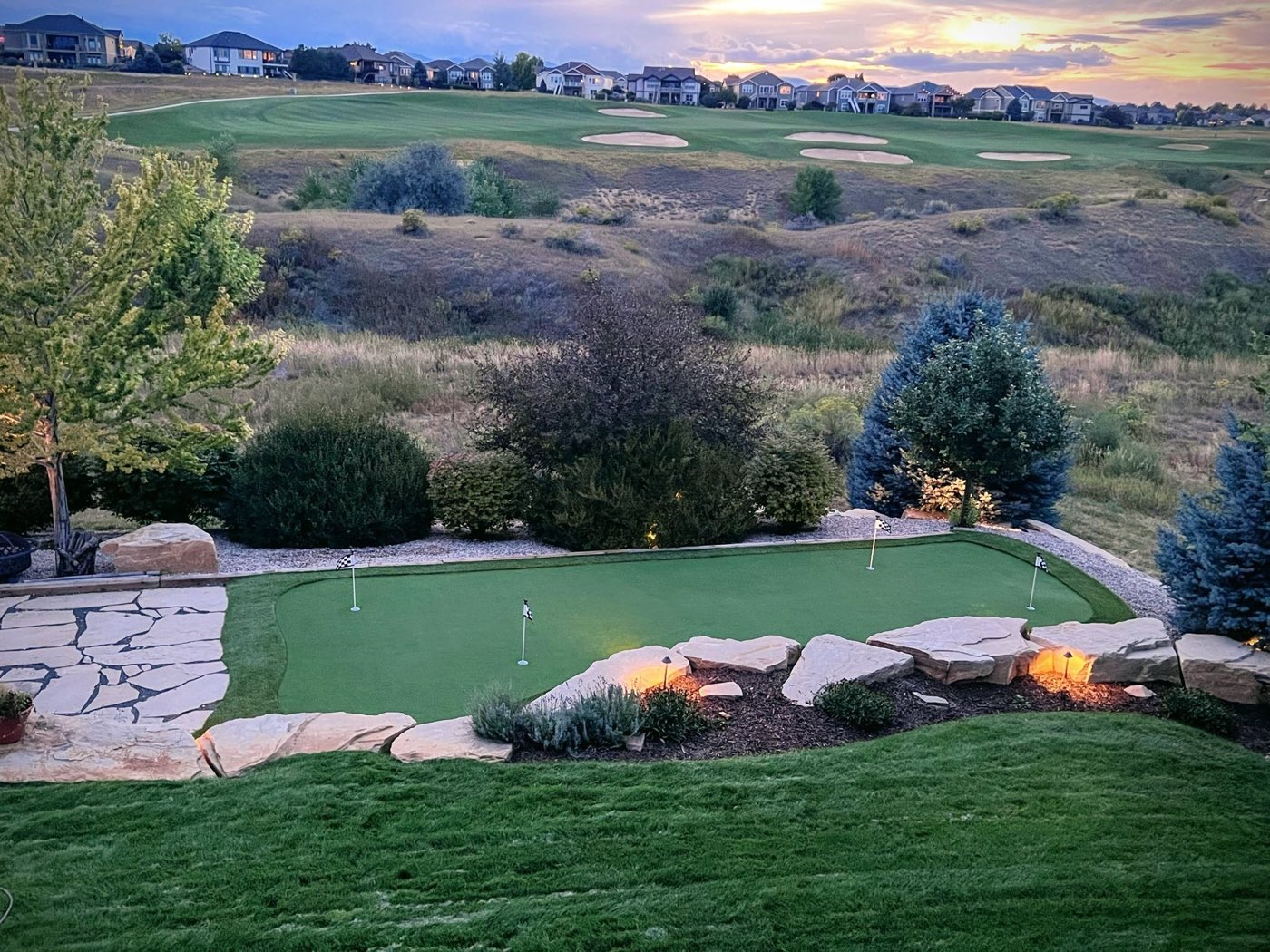
What should you check on a backyard putting green before you buy the house?
Roll balls from several directions to check for drift, lay a straightedge across seams and cups, check sand depth at a few spots, and look for fiber worn thin or gone brittle in full sun. Ask the seller who installed it, the fiber, its age and the last top-dress. TIMELESS Turf Restoration inspects backyard greens across the Grand Strand and says plainly what each finding costs to fix.
Key takeaways
- A roll test from several directions catches drift from a settled base faster than any single putt does.
- A straightedge across seams and around cups shows a gap or a lift that a quick look misses.
- Sand depth, fiber wear and fringe condition each mean something different, and each has its own fix and price.
- A settled base or a backing gone brittle is a different conversation than a green that just needs a restoration; ask which one you have before you close.
Before you look, ask the seller
This walkthrough covers the green only; for the rest of the yard's turf, see our full inspection checklist.
- Who installed it, and roughly when.
- What fiber it is, nylon or polyethylene; see our fiber care guide for what that changes.
- How old the green actually is, separate from how old the house is.
- When it was last top-dressed, and by whom.
A seller with real answers has looked after the green. A shrug on the top-dress question is worth noting on its own.
The roll test: checking for drift, not speed
Roll three or four balls from the same spot toward the middle of the green, then roll the same balls from two or three other directions on the green. A green with a level base rolls straight, or curves the same predictable way every time if it was built with intentional slope. A green with a base that has settled unevenly bends the roll toward the low spot no matter which direction you start from, which is a different tell than the speed itself. Our backyard green speed guide covers measuring how fast a green runs; this test is checking whether it runs true, which matters more to a buyer than the exact number.
Brian prices it by square foot before any work starts, and every job ends blown clean.
Straightedge across seams and around cups
Lay a straightedge across any seam line you can see and across each cup. A seam that reads flush under the straightedge is sound; a gap or a raised edge is a seam repair, from $250. Around a cup, a collar sitting noticeably low or lipped with built-up sand usually means sand has migrated unevenly rather than the cup failing, the same pattern covered on our page about sunk or uneven cups; that is a reset within a normal restoration, not a separate charge.
Sand depth at a few spots
Part the fibers at a cup, at the middle of the green, and near an edge, and compare. Sand that reads noticeably thinner at one of these spots than the others is what a top-dress corrects, covered in the restoration itself; sand that reads thin everywhere on a green nobody has top-dressed in years takes more sand and more of the visit to put right. Our sand depth and speed guide covers why the depth matters as much as the amount.
Fiber wear and the fringe
Run a hand over the putting surface in the sunniest section and check whether the fiber still stands back up or stays flat and brittle. Fiber that springs back is fine; fiber that feels brittle or is visibly worn down to the backing is past what a restoration fixes, one of the end-of-life signs on our restore or resurface guide. Check the fringe separately from the green itself: it is often a different, softer fiber that wears and mats faster under foot traffic, and a matted fringe next to a sound green is a brushing job, not a red flag on the green.
Drainage: a hose test
Run a hose on the lowest-looking spot of the green for five minutes, or check it after a real rain. Water that clears in a few minutes is normal. Water that stands for an hour points to a blocked drain under the green, sand that has compacted enough to stop draining, or a base that has settled into a low spot, the kind of finding that changes the conversation from a restoration to something the base underneath needs to answer for.
What it costs
| Finding | What it usually means | Cost |
|---|---|---|
| Roll drifts one way from every direction | Settled base | Inspection first; a rebuild is a separate quote |
| Seam gap or lift under the straightedge | Seam needs re-securing | From $250 |
| Cup low or lipped with sand | Sand migrated unevenly | Included in a restoration |
| Sand thin at one spot | Due for a top-dress there | Included in a restoration |
| Sand thin everywhere | Overdue for a full top-dress | Restoration, quoted after a look |
| Fiber worn to backing or brittle | Past what restoration fixes | See restore or resurface |
| Matted fringe, sound green | Needs brushing | Included in a restoration |
| Water standing an hour after a hose test | Drainage or a settled base | Inspection first |
A typical backyard green restoration lands in the $299 to $899 range, quoted after we look at yours. Add a seam repair, which starts at $250, and a green needing both starts from about $549 to $1,149; an edge repair instead, from $175, starts the same restoration from about $474 to $1,074. A green with a settled base or failed backing is a different number entirely, one we do not price here since that work goes to our sister company; we tell you which side of that line your green is on before you make an offer. If you would rather we did this walkthrough directly, our listing-prep page covers the seller's side of the same visit.
Free quote, priced by square foot. You approve any add-on before we do it.