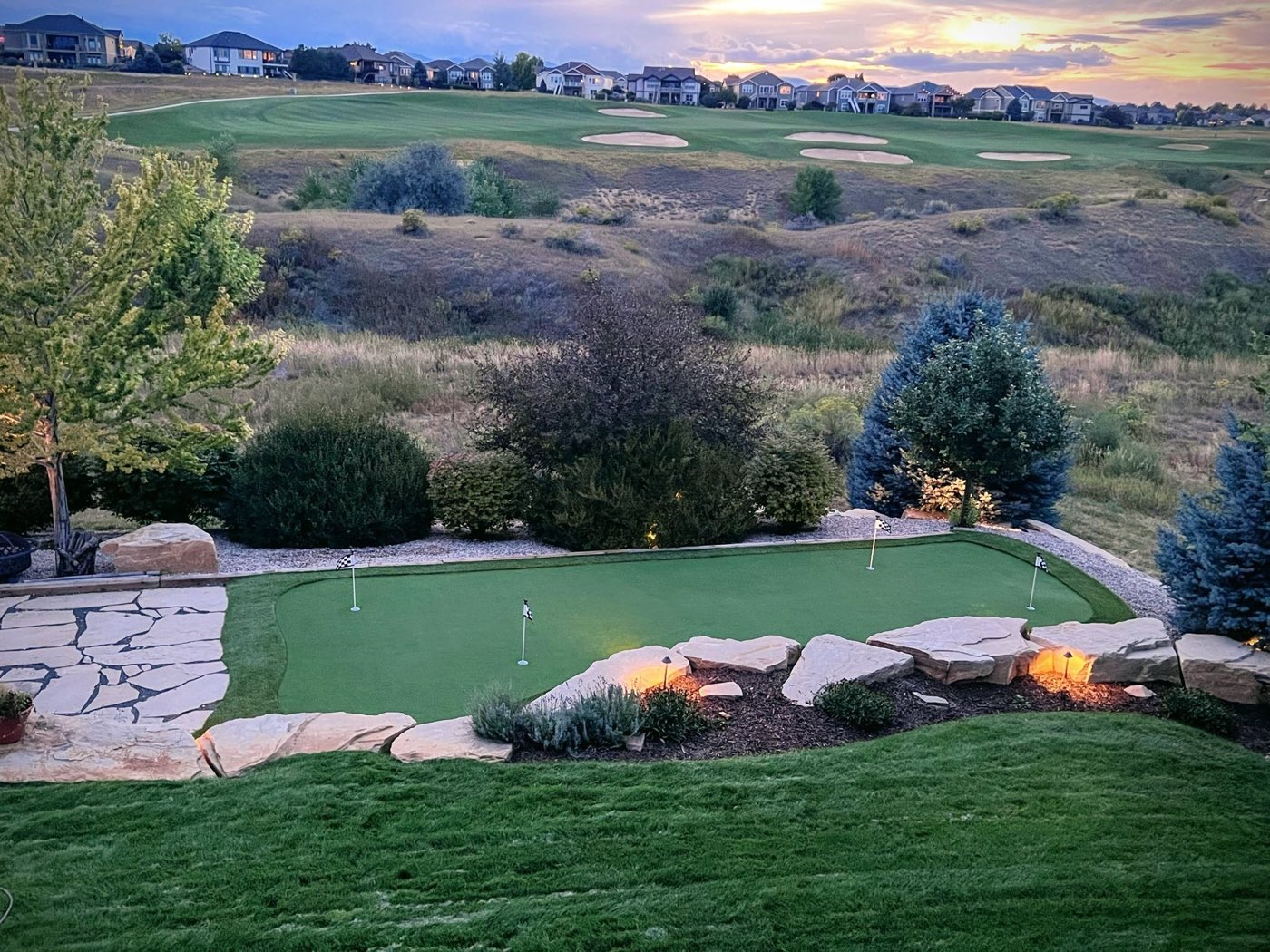
Can an old synthetic putting green be restored, or does it need new turf?
Most greens with worn sand, faded color or a bumpy roll can be restored: cleaned, top-dressed and brushed back to speed. A green is done, not restored, once fibers wear down to the backing, the backing turns brittle or tears, seams keep failing after repair, or the base has shifted. TIMELESS Turf Restoration inspects greens across the Grand Strand and says plainly which side of that line yours is on.
Key takeaways
- Worn sand, faded color or a slow, bumpy roll are usually restoration jobs: clean, top-dress and brush the surface back to speed.
- End of life looks different: fibers worn through to the backing, a backing gone brittle or tearing, a base that has shifted, or seams that keep reopening after repair.
- Resurfacing means installing new turf, and that work goes to our sister company, not us.
- A rebuild is quoted after a walk-through by whoever does that work; we do not price it here.
Signs restoration still works
Most greens that look tired are still sound underneath. Sand that has gone thin or migrated, color that has dulled under a season of pollen and UV grime, a roll that has gone slow or slightly bumpy, a fringe that has crept in around the edges, a cup liner packed with grit: all of that comes back with a clean, a top-dress and a brush, the work described on our putting green restoration page. Fibers that are matted but still intact, still standing back up once brushed and treated, are doing their job. A seam with a faint line rather than a real gap, or an edge that has lifted in one spot, are repairs, not replacements. None of that means a green is finished; it means it has gone a while between visits.
Signs it has reached the end of its life
- Fibers worn to the backing. Once the pile is thin enough to see backing material through it in the high-traffic lanes, brushing and top-dressing have nothing left to lift back up.
- Brittle or tearing backing. A backing that cracks, crumbles or tears when handled has broken down past the point any surface treatment reaches.
- Base failure. Heaving, sinking, or a low spot that holds water no matter how the surface is treated points to what is underneath the turf, not the turf itself.
- Seams that keep failing. A seam repaired once and gapping again within a season or two usually means the base or adhesive underneath has failed, not that the tape needs redoing.
- UV-degraded fibers. Fibers that have gone brittle, snap rather than bend, or stay faded after a clean have broken down at the fiber level, not just picked up dirt.
Brian prices it by square foot before any work starts, and every job ends blown clean.
Symptom by symptom: restore or replace
| Symptom | Usually restoration | Usually replacement |
|---|---|---|
| Slow or bumpy roll | Yes, sand depth or compaction | — |
| Dull, dirty color | Yes, cleaning and top-dress | — |
| Thin sand, backing color showing through evenly | Yes, top-dress restores it | — |
| Fibers worn through to the backing | — | Yes, nothing left to restore |
| Cracking or tearing backing | — | Yes |
| Low spot holding standing water | — | Yes, base problem |
| One lifted edge or a faint seam line | Yes, a repair, not a rebuild | — |
| A seam that reopens after repair | — | Usually, base or adhesive failure |
What resurfacing actually means
Resurfacing means taking up the existing turf and installing new turf, sometimes over the same base and sometimes over a rebuilt one if the base has failed too. It is a full install, not a deep clean, and it is not work TIMELESS Turf Restoration does; we clean, treat, top-dress and repair the turf already in the ground. That install and any base rebuild go to our sister company, TIMELESS Grass & Greens, which handles exactly that side of the work. If an inspection points to replacement rather than restoration, that is the honest answer, rather than stretching a restoration onto a green that cannot hold one.
The arithmetic, without a rebuild number
We do not price a rebuild here, since that is quoted after a walk-through by whoever does the install. What we can say is how to think about the decision. A green that is structurally sound and just needs a restoration, typically $299 to $899 for a backyard green depending on size and condition, is a small, recurring cost against years more of use. A green with base failure or a backing coming apart is a different equation entirely: no amount of restoration holds on a surface with nothing solid to sit on, so paying for one anyway is money spent on a green that fails again regardless. Our lawn guide on cleaning versus replacing artificial turf walks through that same logic in more detail for a flat yard; the reasoning carries over even though a green's failure signs look different.
When to call us
Call for an inspection any time a green looks tired and you are not sure which side of this it is on. A restoration, when that is the right call, follows the same putting green restoration pricing as any green we quote, typically $299 to $899 depending on size and condition. If the base or backing has failed, we say that too, and point you to our sister company for a rebuild quote rather than take on a job that cannot last.
Free quote, priced by square foot. You approve any add-on before we do it.